
Dependency Inversion Principle#
Important
High-level modules should not depend on low-level modules. Both should depend on abstractions (e.g., interfaces).
Abstractions should not depend on details. Details (concrete implementations) should depend on abstractions.
Instead of high-level code (e.g., application logic) being tightly coupled to low-level code (e.g., specific implementations), both should rely on an abstraction (like an interface or abstract class). This helps reduce dependency between components and makes the system more adaptable to changes.
Example of DIP#
Let’s consider a simple example when using a button we want to turn on a LED indicator.
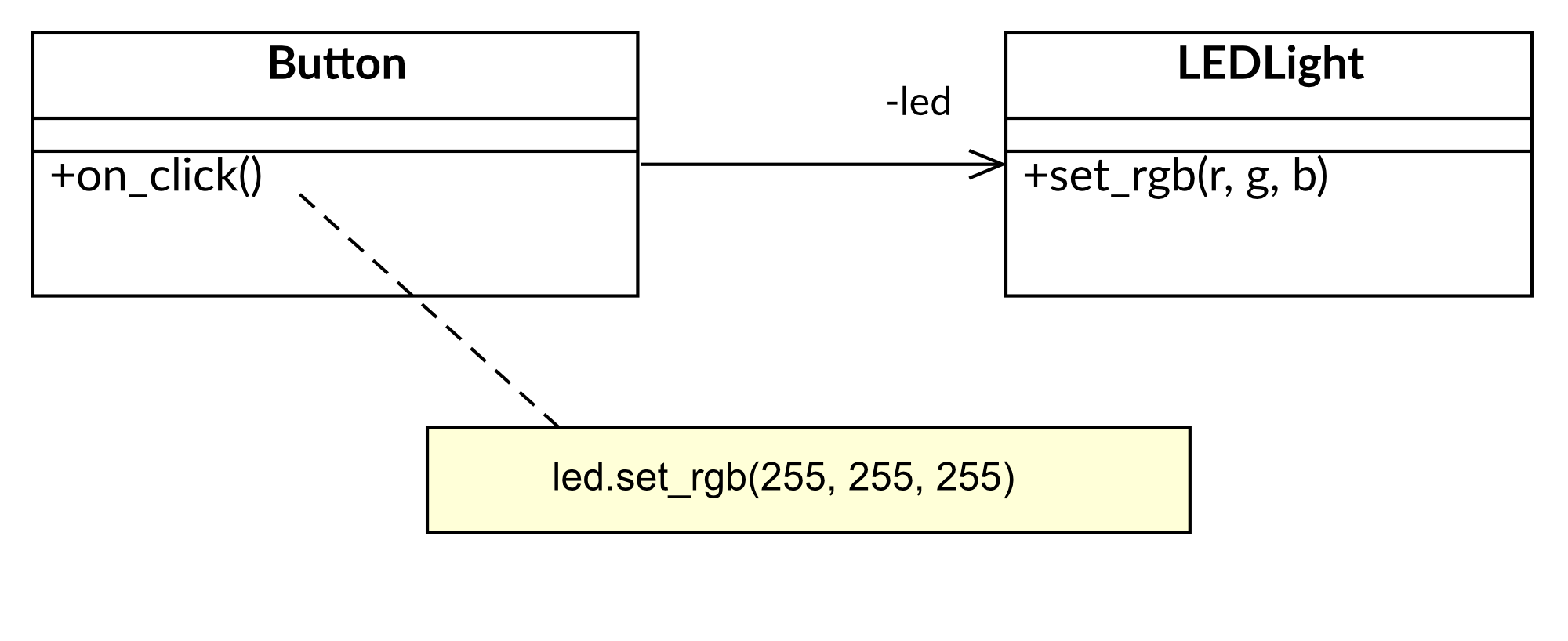
When ToggleButton uses the LEDLight class directly to turn on the light, it creates a tight coupling between the two classes. If we want to change the LED implementation (e.g., to a different type of light), we would need to modify the ToggleButton class.
This kind of design violates the Dependency Inversion Principle:
The high-level module (
ToggleButton) depends on a low-level module (LEDLight). When we want to turn on the light we need to directly callset_rgb(255, 255, 255)method of theLEDLightclass. We push the knowledge how the low-level module works into the high-level module (we need to know what is RGB color space in order to use the LED light properly).If we are forced to use different LED light implementations, we need to modify the
ToggleButtonclass. Thus changes in the low-level module require updates in the high-level module code.
To comply with the Dependency Inversion Principle, we can introduce an interface called ISwitch that defines the methods for turning on and off the light.
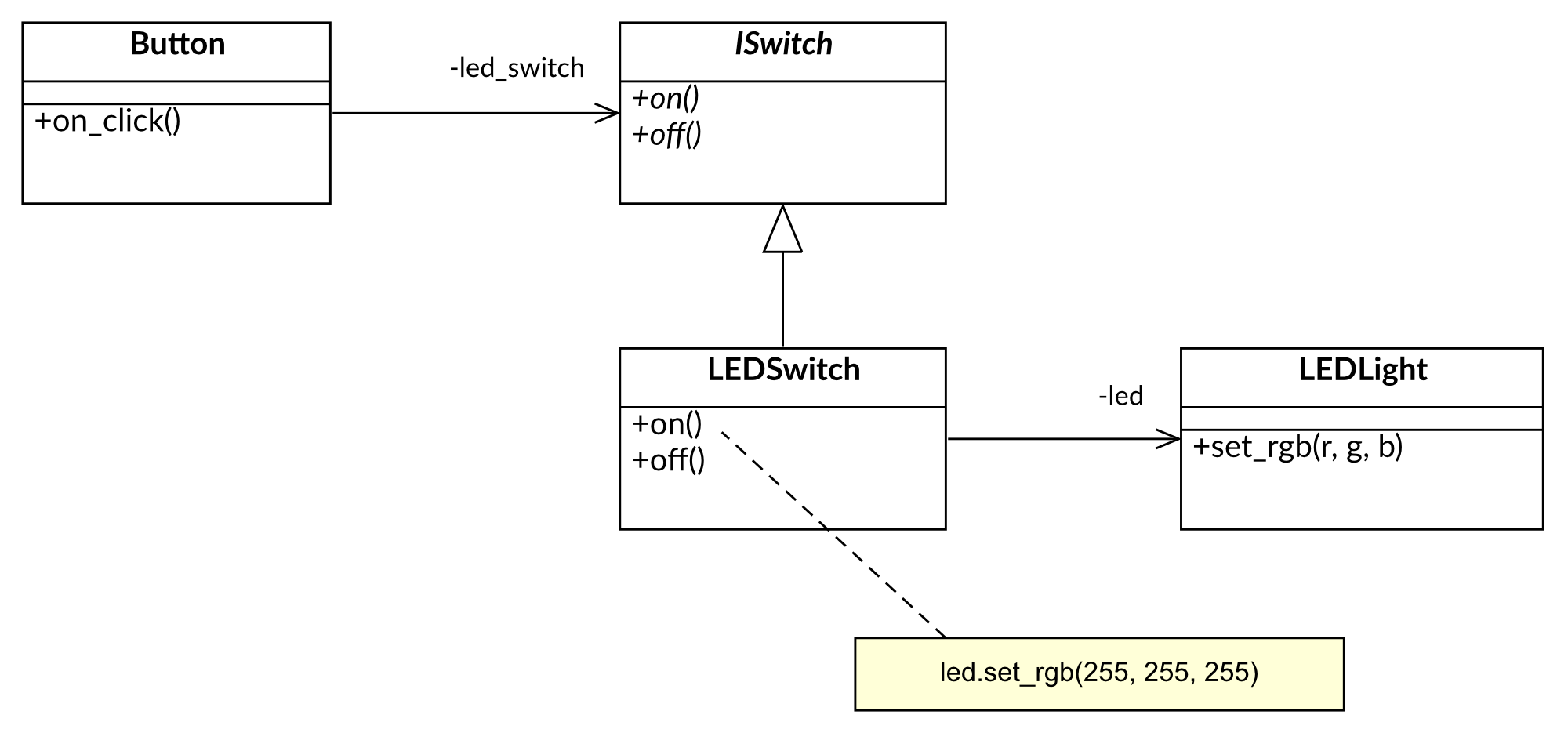
The ISwitch interface defines the methods on() and off() that the ToggleButton class can use without knowing the details of how the light works. This interface reflects what high-level module needs to operate. The LEDSwitch class implements this interface and provides the specific implementation for turning on and off the LED light. This is a part of a low-level module that depends on the ISwitch interface. Now both high-level and low-level modules depend on the abstraction (ISwitch interface), not on each other. The LEDSwitch works as an adapter that adapts the LEDLight class to the ISwitch interface created for a high-level module.
Future changes in the low-level module (e.g., changing the LED light implementation) will not affect the high-level module (ToggleButton class). The ToggleButton class can work with any implementation of the ISwitch interface, making it flexible and adaptable to changes.
Benefits of DIP#
Encourages the use of abstractions: Promotes flexibility and reusability by decoupling high-level and low-level modules.
Encourages loose coupling between components: Makes your application easier to test and maintain.
Facilitates separation of concerns across architectural layers: Aligns with best practices for clean architecture.